Business applications
Internal apps for employees, teams and operational workflows.
Mobile product engineering
Build high-quality Android and iOS applications from a shared Flutter codebase—with the architecture, integrations and native capabilities your product actually needs.
Application architecture
01 · Flutter UI
Screens and user interaction
02 · Application logic
State and workflows
03 · Secure API
Backend communication
04 · Backend and data
Business rules and records
05 · External services
Connected product capabilities
Plan • Design • Engineer • Integrate • Test • Maintain
Framework and delivery
Flutter is a UI and application framework for building applications for multiple platforms from a shared codebase.
A shared foundation can support consistent interfaces, reusable components, cross-platform delivery and faster product iteration. It still takes careful application architecture, API and backend integration, testing and release planning. Some device capabilities require platform-specific implementation; shared code does not eliminate every native requirement.
Cross-platform
Android and iOS from shared application code.
Consistent UI
Reusable components and a coherent design system.
Product iteration
Shared logic can simplify updates across platforms.
Rich interfaces
Custom UI that follows product workflows.
Device capabilities
Integrate platform capabilities where required.
Maintainability
Reduce duplicated application logic where appropriate.
Flutter is not the right default for every product. Platform needs and long-term ownership should guide the choice.
Application types
These are application capabilities and use cases, not claims of existing customer projects.
Custom application development
Custom mobile software should follow business needs rather than force a team into a generic template.
We plan the application around user roles, workflows, APIs, databases, authentication, permissions, notifications, device capabilities, reporting and the integrations it depends on. A Flutter app may also be a mobile layer for an existing web platform or business system.
Application engineering
Choose an architecture that supports the product's features, testing needs and expected change. One pattern is not right for every app.
Screens, components and interaction
Screen state, loading and user actions
Product rules and use cases
Data access and integration boundaries
Authenticated requests and business logic
Persisted records and external capabilities
Connected products
A Flutter app can provide interfaces for assistants, AI search, document processing, recommendations, workflows and agents.
A suitable architecture is Flutter app → secure backend → AI integration layer → AI service and approved business data or tools. Keep sensitive AI credentials on the server, and design permissions, validation and human review around the feature.
SaaS products
Mobile companions, customer and employee applications, admin interfaces and multi-tenant clients can extend SaaS products.
Plan authentication, tenant isolation, API boundaries, role-based access, feature availability and usage limits with the SaaS backend.
SaaS developmentA Flutter app can connect through a business API to CRM, ERP, inventory, booking, employee management, field operations or business management software: mobile app → business API → custom application → database.
Performance and security
Measure real bottlenecks and optimize against the application's user journeys.
Potential areas include widget efficiency, images, network requests, caching, unnecessary rebuilds, state handling, pagination, lazy loading, startup and memory use. Improvements depend on measurement; exact benchmarks are not assumed.
Release and ownership
Plan release builds, test supported platforms, prepare store materials and coordinate production rollout.
Deployment can include Google Play and Apple App Store preparation. Store review and approval are controlled by each platform and cannot be guaranteed.
Modernization
Legacy apps, duplicated Android/iOS implementations, outdated dependencies or hard-to-maintain code may benefit from assessment. Start with the current architecture and requirements. Not every native application should be rewritten in Flutter; migration should be justified by the product and operating model.
Delivery
Product decisions and engineering remain connected through the full mobile lifecycle.
Understand users, business goals, constraints and requirements.
Map screens, workflows and user journeys.
Define app structure, APIs, data boundaries and integrations.
Build reusable Flutter components and product screens.
Connect APIs, authentication, data and external services.
Validate functionality, supported devices, network conditions and edge cases.
Prepare production builds and support release processes.
Plan updates, fixes and product improvements over time.
Product examples
These are possible project types, not claims of completed client work.
Potential use cases
Potential applications vary by business, users, data and operating requirements.
Healthcare
Patient interfaces, appointments and administrative workflows.
Hotels and hospitality
Guest apps, booking and service requests.
Gyms and fitness
Membership, schedules, training and engagement.
Retail
Product discovery, orders and customer accounts.
Professional services
Client portals and business workflows.
Field services
Employee tasks and status updates.
Business operations
Internal employee and management apps.
Verified portfolio
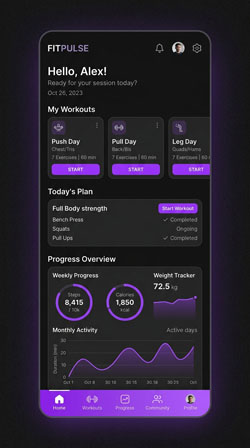
FitFlex Companion is a verified JoomRocks Flutter project and mobile counterpart to the TrainZo ecosystem.
The portfolio describes a Flutter and Dart application for gym members to access workouts, track progress, log meals and view attendance and membership information. Its listed technologies include Firebase, REST API and HealthKit. These are project-specific details, not a claim that every Flutter project uses the same stack.
FitFlex Companion · Flutter mobile application
Technology and engineering
The verified FitFlex portfolio lists Flutter, Dart, Firebase, REST API and HealthKit. Other project choices should follow the requirements and existing systems rather than a fixed technology checklist.
Application engineering can involve mobile UI, backend services, APIs, data, authentication, cloud services, device capabilities, testing and release automation. Specific services and tools are selected for the project; technologies are not included as decoration.
Why JoomRocks
Our work spans custom software, business systems, APIs, backend development, SaaS, CRM/ERP, AI integration, web engineering and mobile products.
We don't just build mobile screens. We engineer the application behind them.
That means connecting product planning, user experience, data, integrations, testing and long-term maintenance.
Questions
Flutter is a UI and application framework for building applications for multiple platforms from a shared codebase. Apps can still require platform-specific implementation for particular native capabilities.
Yes. Flutter supports cross-platform application development for Android and iOS from shared application code, with platform testing and platform-specific work where the product requires it.
Flutter can support shared application logic, consistent UI, reusable components and efficient product iteration across platforms. Whether it fits depends on product requirements, device features and the maintenance plan.
Cost depends on platforms, features, UI complexity, backend requirements, integrations, authentication, device capabilities, testing and overall scope. An estimate requires understanding the product.
Timing depends on product scope, design, data and backend readiness, integrations, device features, review cycles and testing. We define milestones after discovery rather than promise one timeline for every app.
Yes. A Flutter app can communicate with backend services through APIs. Integration work covers authentication, data formats, pagination, validation, error handling and session behavior.
Potentially, through a suitable backend or supported API. The mobile app should not bypass the system's authorization and business rules; feasibility depends on the existing systems.
We can build mobile experiences for SaaS products, including user roles and tenant-aware access through the product backend. The product's API and access model shape the approach.
Yes. A Flutter app can provide the interface to AI capabilities through a secure backend and AI integration layer. Sensitive AI credentials should not be embedded in the mobile app.
Offline behavior can include selected cached data, queued operations and later synchronization. The right scope depends on the data model and conflict behavior; complete offline use is not automatic.
Flutter apps can use device capabilities where supported. Some features need platform-specific implementation, and behavior can differ between Android and iOS.
We can prepare release builds and support deployment tasks within the project scope. Store review and approval are controlled by the platform and cannot be guaranteed.
Maintenance can include bug fixes, compatibility work, dependency updates, security improvements, performance, API changes and new features, scoped to the existing codebase.
We can assess the current app, capabilities, architecture and migration risks. Rewriting is not automatically the right choice; a staged modernization or continued native development may fit better.
Neither is universally better. Flutter uses Dart and its own UI system; React Native uses the JavaScript or TypeScript ecosystem and a React-based development model. The choice depends on product needs, existing skills, platform integrations and maintenance plans.
Plan the product, then build it
Let's design the architecture, user experience and technology needed to turn the idea into a production-ready Flutter application.
Tell us about your mobile application, target platforms, required features, backend integrations and existing development progress. We can discuss a suitable Flutter implementation.

We build scalable SaaS platforms, automation systems, and custom web applications for growing businesses.
Have a project idea? Let’s discuss and build something great.
Get Free Consultation